
.webp)
A patio can become the center of a Texas backyard. It creates a stable place for dining, grilling, relaxing, and connecting features such as a pool, pergola, outdoor kitchen, lawn, or garden. The material you select will affect the space's appearance, comfort, maintenance, repair needs, and long-term usefulness.
For many homeowners, the choice comes down to pavers vs concrete patio construction. Poured concrete is familiar and often costs less at the beginning. Pavers provide more design flexibility and make localized repairs easier. The right answer depends on your property, budget, style, and plans for the backyard. A thoughtful comparison should also consider whether the patio will support future construction later, since adding a pool, kitchen, pergola, or covered seating area can affect elevations, utilities, drainage, and access.
This guide compares concrete and pavers for North Texas homes, including cost, care, durability, repairs, and value. It can also help you plan a larger backyard remodeling project.
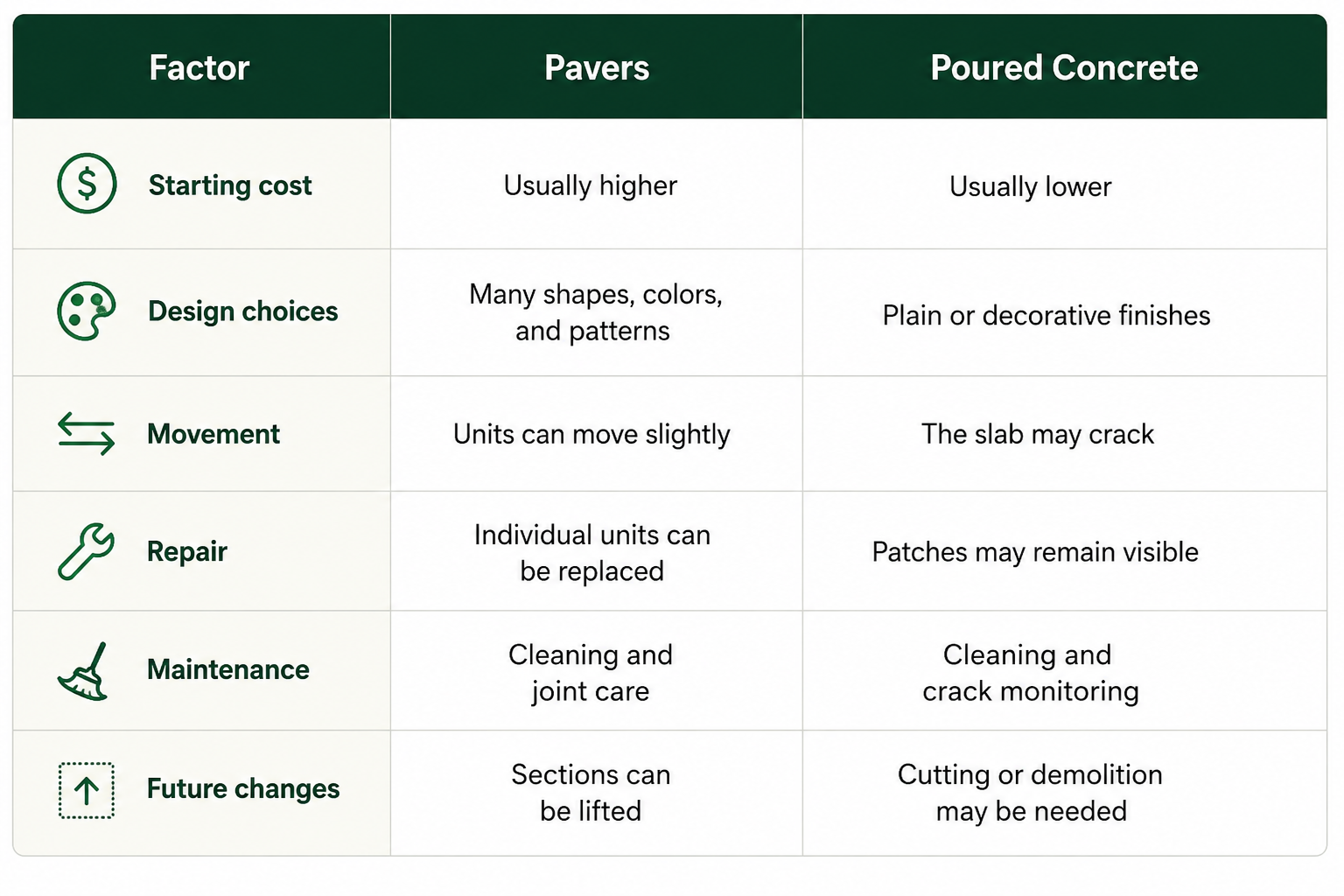
Excavation, drainage, access, size, finish, and installation quality can change the final result.
North Texas backyards experience strong sun, heavy rain, temperature changes, and soil movement. A patio should therefore be designed as a complete system with excavation, a stable base, grading, drainage, edging, and a suitable finished surface.
A patio can settle or hold water when its base is poorly prepared. Professional hardscaping services should begin with a site assessment.
Concrete acts as one large slab. Control joints help manage cracking, but they cannot make an exterior slab crack proof. A paver patio consists of separate units, so the joints allow limited movement. Pavers can still settle when the base, drainage, or edge restraint is inadequate.
The cost of concrete patio vs pavers is often the first question. Basic concrete commonly has a lower upfront price because the material layout is simpler. Paver installation involves more handling, cutting, pattern work, edge restraint, and joint finishing.
A complete quote should consider:
Decorative concrete can narrow the price difference because color, stamping, and complex forms add cost. Paver prices also vary by material.
Concrete may suit a simple utility patio, while pavers provide more flexibility for design, access, and repairs.
Homeowners often compare a stamped concrete patio or pavers. Stamped concrete is poured as one slab and patterned to resemble brick, stone, or tile.
However, stamped concrete remains one continuous slab. If it cracks, the line can cross the pattern and become difficult to hide. Matching an older color and texture during repair may also be challenging.
Paver patterns come from individual units. Colors, borders, sizes, and layouts can complement the home, and limited sections may be lifted for future access.
Stamped concrete can be a practical choice for a decorative but straightforward surface. Pavers are often better for detailed design, easier sectional repair, and future flexibility.
Understanding the paver patio pros and cons helps determine whether the added initial investment supports your goals.
Pavers suit traditional, rustic, contemporary, or resort-inspired properties. Borders can define dining spaces, paths, pool decks, and turf transitions.
They are also easier to repair in sections. A chipped, stained, or settled unit can often be removed without replacing the full patio. This is useful around pools and outdoor kitchens, where future access to utilities may be necessary.
Pavers fit naturally into a coordinated outdoor living space. The surface can be designed around a pergola installation, cooking station, pool, fire feature, or turf area.
Pavers usually cost more than basic concrete. Their joints also need attention because sand can wash out and debris can collect.
An inadequate base can cause dips or uneven areas. Repairability is helpful, but it should never replace proper excavation, compaction, drainage, and edge restraint.
The concrete patio pros and cons reflect its main strength: a practical, continuous surface at a competitive starting cost.
A basic slab provides a clean appearance and can receive a broom finish, color, exposed aggregate, or stamped texture.
Its continuous surface can work well for furniture, rolling carts, easy sweeping, and modest patios.
Cracking is the most familiar drawback. Reinforcement, slab thickness, control joints, drainage, and good preparation reduce risk, but they cannot guarantee a crack-free surface.
Repairs may remain visible because new concrete rarely matches an older slab perfectly. Major changes can require cutting, demolition, and repouring. Once decorative finishes are added, the price advantage over pavers may also become smaller.
Effective concrete patio maintenance includes cleaning the surface and checking how water moves around it. Leaves, grease, dirt, and organic growth can stain concrete or make shaded areas slippery.
Routine care includes gentle washing, stain removal, clear drains, and resealing when appropriate. Monitor widening or uneven cracks that may signal movement.
Keep downspouts from discharging at the slab edge. Repeated water flow can affect the soil beneath or beside the patio. Pool chemicals, grill grease, metal furniture, and planters can also leave marks, so address spills and rust promptly.
Pavers require normal cleaning plus occasional attention to joints and edges. Remove soil and leaves before they accumulate between units. Watch for joint loss, loose borders, low areas, and poor drainage after rain.
Professional paver patio repair may involve lifting the affected units, correcting the base, resetting the surface, and replacing joint material. This sectional process is one of the clearest benefits of pavers. Repairs can blend well when matching units are available.
The correct sealer depends on the paver material. Keep a few extra units from the original project for future repairs.
Pool patios need drainage, traction, and smooth connections to coping, steps, furniture, and landscaping.
Pavers can follow curves and detailed edges easily. They also allow a limited area to be opened if underground work becomes necessary. Material selection matters because texture and surface temperature vary.
Concrete creates a continuous deck and may be economical across a large space, although repairs can be noticeable.
When updating an existing pool, coordinate the patio with a broader pool remodeling plan. For a new backyard, include the deck, drainage, equipment, access, and entertainment zones during new pool construction.
The best patio material is the one that fits the property and your priorities.
Choose pavers for custom patterns, defined borders, easier sectional repairs, and a strong visual connection between outdoor features. Choose concrete when a simple continuous surface and lower basic installation cost matter more than customization.
A combination can also work. Pavers may define the entertaining zone while artificial turf softens nearby areas.
The design should account for doors, grade changes, water flow, utilities, trees, pools, and future additions. A good material in the wrong layout will not produce a successful backyard.
Many owners ask, does a paver patio increase home value? A well-designed patio can improve buyer appeal by making the yard feel finished, usable, and ready for entertaining. Pavers may create a more custom impression than plain concrete when their pattern and color complement the home.
No material guarantees a specific return. Value depends on quality, condition, neighborhood expectations, and a balanced layout.
The strongest impression often comes from a complete experience. A patio connected to an outdoor kitchen installation, shaded seating, pool, and planting areas can feel like a true extension of the house.
During major backyard remodeling, the patio determines where people walk, cook, sit, and gather. It also affects the location of drainage, utilities, structures, and landscape beds.
Decide how the space should function. Plan dining furniture, grills, shade, pool traffic, paths, and utility lines before installing the final surface.
A professional paver patio installation can serve as the foundation for a pergola, outdoor kitchen, pool deck, turf, and landscaping. Planning those features together prevents awkward elevations, narrow paths, misplaced posts, and competing finishes.
Homeowners seeking hardscape installation services in Southlake should choose a team that can coordinate the patio with the full backyard design, not just install a surface in isolation.
A well-built concrete patio can outperform poorly installed pavers, and properly installed pavers can outlast a weak slab. The material name does not determine success by itself.
For concrete, ask about preparation, thickness, reinforcement, joints, slope, and curing. For pavers, ask about excavation, compacted base, bedding material, edge restraint, drainage, joint material, and final compaction.
A detailed proposal should cover base work, demolition, access, utilities, drainage, and transitions.
RP Landscape provides paver installation in Fort Worth within a broader range of outdoor construction services. Homeowners can view completed outdoor projects, read about RP Landscape, and request a site-specific recommendation.
For homeowners focused on a practical surface and lower starting cost, basic poured concrete may be the better fit. For those who want design flexibility, localized repair, and a custom foundation for a larger outdoor project, pavers are often worth the investment.
Compare the complete project, including base work, drainage, maintenance, repairs, future additions, and daily use.
RP Landscape helps homeowners plan patios and larger outdoor projects throughout Fort Worth, Southlake, Colleyville, Westlake, Grand Prairie, and nearby DFW communities. Contact RP Landscape to request a consultation for a paver patio, pool area, pergola, outdoor kitchen, or coordinated outdoor living project.
Pavers can accommodate limited movement because they are separate units. Concrete is one slab and may crack as the ground changes. Both options still require proper excavation, compaction, grading, drainage, and installation.
Pavers usually cost more upfront than basic poured concrete. Decorative or stamped concrete can reduce the difference. Compare complete proposals that include demolition, base work, drainage, borders, access, and finishes.
Pavers need cleaning plus joint and edge checks. Concrete requires cleaning, crack monitoring, and care for stains or sealer wear. Neither is maintenance free, but pavers generally make localized repair easier.
Sometimes, the slab must be stable, correctly sloped, and suitable for the added height. Door thresholds, drainage, steps, and nearby elevations must be evaluated. Removal may be better when the concrete is cracked or poorly graded.
Longevity depends on preparation, drainage, material quality, use, and maintenance. Pavers offer an advantage when individual pieces need replacement. Concrete can remain serviceable for many years but may be harder to restore neatly after settlement.
Arrange a site visit so the contractor can assess dimensions, access, grading, drainage, demolition, materials, and connected features. You can request a patio consultation from RP Landscape for a project-specific plan.




.svg)
.svg)