
.webp)
A backyard pool should be the best part of your property. But if the area surrounding it is cracked concrete, muddy grass, or slippery pavers, it quickly becomes a headache to maintain and an eyesore to look at.
More homeowners across Fort Worth, Southlake, and Colleyville are making the switch to artificial turf around pool areas, and the results speak for themselves. Clean, green, and low-maintenance, artificial turf transforms a pool surround from a problem zone into the polished outdoor space it should be.
At RP Landscape, we install professional-grade artificial turf for pool areas throughout North Texas. This guide covers everything you need to know, design options, material selection, installation process, cost, and the honest pros and cons. so you can make a confident decision for your property.
Natural grass around a swimming pool is one of the most challenging landscapes to maintain. Constant water exposure from splashing, heavy foot traffic from swimmers, and pool chemical runoff all work against it. The result is usually patchy, muddy, or brown grass, even with regular care.
Artificial turf around a pool eliminates these problems entirely. It stays green and uniform regardless of how much water hits it, how many people walk across it, or how intense the Texas summer gets. It doesn't track clippings into the pool water, and it doesn't require irrigation that competes with the water your pool already uses.
For families in Fort Worth and Southlake who want a backyard they can be proud of, and actually use, synthetic grass around pool areas has become an obvious upgrade.
Artificial grass pool surrounds aren't one-size-fits-all. There are several approaches depending on your pool's shape, your existing hardscape, and the look you want to achieve.
The most popular approach, turf, replaces all natural grass and soil in the pool surround area, running right up to the pool coping edge or a narrow border of pavers. This creates a lush, carpet-like effect that makes the pool the clear focal point of the backyard.
Combining artificial turf for pool areas with concrete or stone paver borders is one of the most elegant design solutions available. Pavers define walkways, transition edges, and seating zones while turf fills the softer areas between. The contrast of hard and soft materials creates a polished, intentional look.
For pools already surrounded by a concrete deck, turf can be integrated as accent strips or inset panels within the existing hardscape. This approach refreshes the look without a complete tear-out and adds color and softness to what would otherwise be a hard, grey surface.
Concrete and artificial turf around the pool is a hybrid approach that maximizes the strengths of both materials. Concrete provides a durable, firm surface around the pool edge and under furniture, while turf fills the broader lawn areas, softens the visual landscape, and stays comfortable underfoot in bare feet.
Let's be specific about what makes artificial grass around swimming pools work so well in the North Texas climate.
Wet concrete and stone pavers are notoriously slippery. Quality artificial turf for pool surrounds is engineered with a textured surface that maintains traction even when saturated. This is one of the most practical safety benefits, especially for families with children.
On a 95°F Fort Worth summer afternoon, solid concrete can reach surface temperatures well above 130°F. That's a genuine burn risk for bare feet. Fake grass around swimming pool areas stays significantly cooler than concrete or dark stone, and a quick rinse with a hose cools it down further in minutes.
When natural grass gets wet, it softens and churns under foot traffic. Swimmers tracking across a wet natural grass lawn bring dirt, grass clippings, and mud right into the pool water. Artificial grass around the pool eliminates that entirely, the surface drains fast and stays clean.
No mowing along the pool edge. No fertilizing. No irrigation system dedicated to pool-area grass. No reseeding bare spots worn down by foot traffic. With artificial turf, the pool area takes care of itself.
Quality pool-area turf is specifically manufactured to resist the chemical exposure that comes with pool ownership. UV-stable fibers and chemically inert backing materials mean the turf won't degrade from regular water and chemical contact.
No product is perfect, and the pros and cons of artificial grass around pool installations are worth understanding before you commit. At RP Landscape, we believe in giving homeowners honest information, not just a sales pitch.
Understanding both sides helps you make the right call. For most Fort Worth and Southlake homeowners with pools, the long-term benefits far outweigh the upfront cost and the minor summer warmth factor.
Artificial turf around pool cost is one of the most common questions RP Landscape receives. The honest answer is that pricing depends on the size of the area, the turf product selected, and the complexity of the installation.
Here's a general cost framework for pool-area turf installations in the Fort Worth and Southlake market:
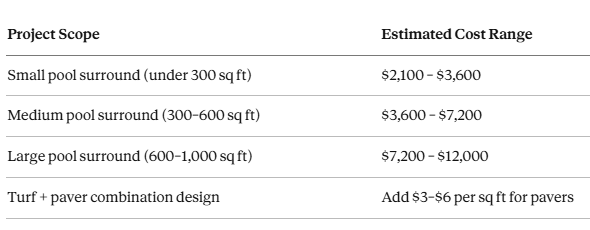
These ranges reflect professionally installed systems with proper base preparation, drainage, and quality turf products. The pool with artificial grass installations that fail within a few years are almost always the result of inadequate base work or low-grade materials, not the concept itself.
RP Landscape provides free, itemized on-site estimates. You'll know exactly what you're paying, broken down by materials and labor, before any work begins.
A quality artificial turf around swimming pool installation follows a precise sequence. Here's how RP Landscape approaches every pool surround project:
We evaluate the existing surface, drainage patterns, pool coping conditions, and the overall space. This determines base depth, drainage design, and turf product selection.
Existing grass or soil is removed and the area is excavated to the correct depth. For pool surrounds, we pay special attention to slope and grade, water must flow away from the pool structure and drain efficiently through the turf system.
A compacted crushed aggregate base is installed to provide stability and drainage. This layer is the foundation of a long-lasting installation, and the step most often skipped by underprepared installers.
Turf rolls are cut precisely to fit the pool surround, including curves around coping edges and transitions to pavers or concrete. Clean, tight seams are essential, gaps or overlaps are visible and compromise the finished look.
Infill material is distributed evenly through the turf fibers to support blade orientation, add weight, and enhance drainage. We hand-brush the entire surface to achieve a natural, upright finish before final inspection.
Most standard pool surround installations are completed in one to two days. Larger or more complex designs may take two to three days depending on site conditions.
RP Landscape has served Fort Worth, Southlake, Colleyville, Grapevine, and surrounding North Texas communities since 1995. Our family-owned team brings over 25 years of landscaping experience to every project, including the specific knowledge of what works and what doesn't in the Texas climate.
We source professional-grade turf products rated for UV resistance, drainage performance, and chemical compatibility for pool environments. We prepare every base correctly. And we stand behind our work.
When you contact RP Landscape for a pool turf installation, you get a free on-site visit, an honest assessment of your space, and a fully itemized quote, no vague estimates, no hidden charges after the job.
Yes. Quality pool-area turf is manufactured to withstand constant water exposure, UV rays, and pool chemical splash. RP Landscape selects turf products specifically rated for pool surround applications, non-toxic, chemically inert, and built to last.
Professional-grade pool turf uses fully permeable backing that allows water to pass through at rates of 30 or more inches per hour. Combined with a properly graded crushed aggregate base, the system drains quickly and prevents standing water from forming.
Quality turf stays measurably cooler than concrete or dark stone in direct sunlight. On a 95°F day, turf surface temperatures run significantly lower than hard surfaces. A quick rinse with a garden hose brings the temperature down further within minutes.
In some cases, yes, turf can be installed over concrete as a surface layer. However, proper drainage must be verified and the concrete surface must be in good condition without significant cracking. RP Landscape evaluates the existing surface during the free estimate visit.
With professional installation and quality materials, pool-area artificial turf typically lasts 15–20 years. The biggest factors affecting lifespan are base preparation quality, product UV rating, and basic periodic maintenance like rinsing and brushing.
Call us at (817) 756-9591 or fill out the request form at rp-landscape.com. We'll schedule a free on-site visit, assess your pool surround, and provide a transparent written estimate the same day, no obligation required.




.svg)
.svg)